200 million agent payments, and about $28,000 a day of commerce
The payment rails for AI agents work. The published numbers show that commerce has not followed yet, and I think the reason is that nobody can stand behind what an agent agrees to.
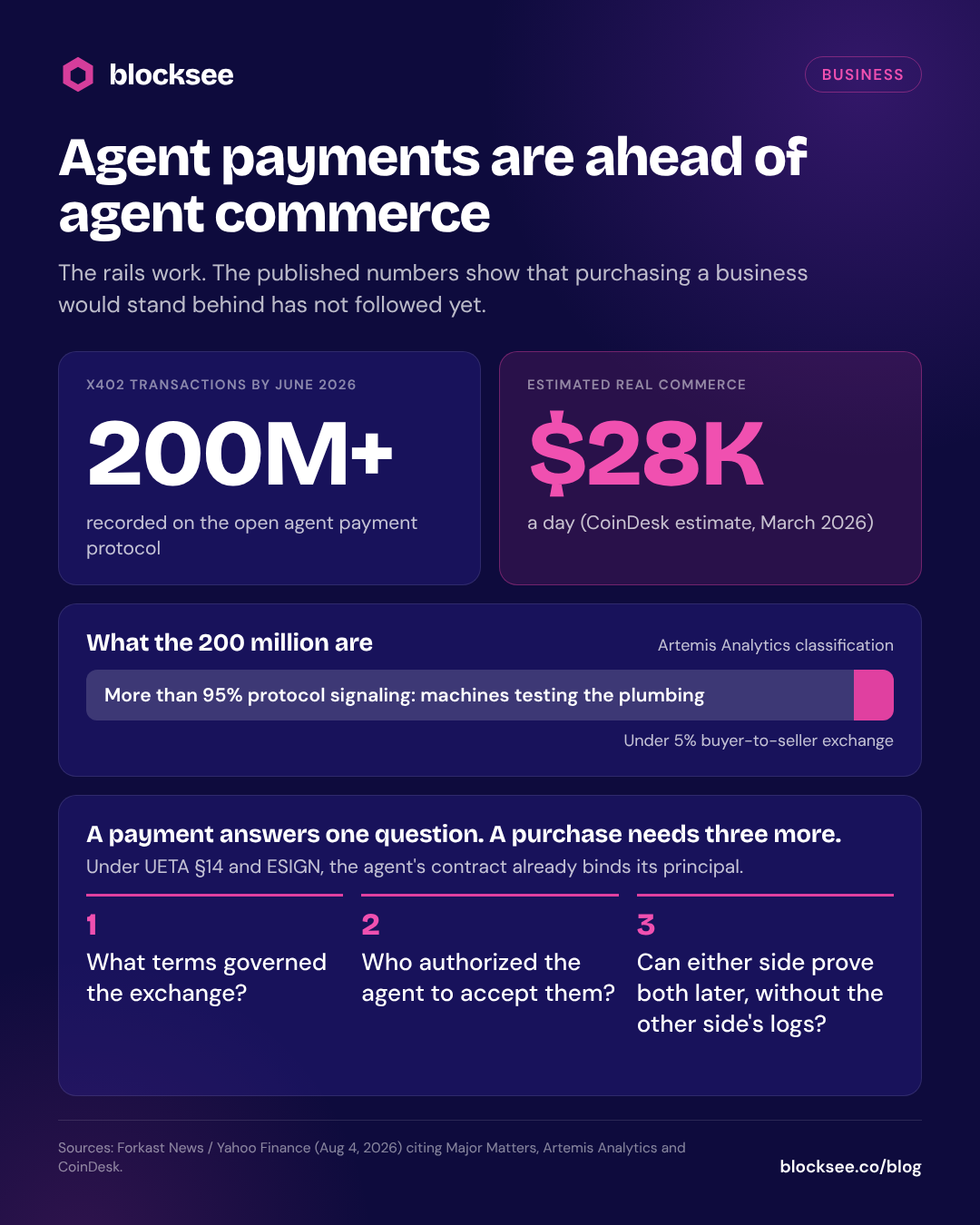
The most quoted number in agentic commerce is the transaction count on x402, the open protocol that lets software pay for things over HTTP. By June 2026 that count had passed 200 million. In July the protocol moved into a Linux Foundation project with 40 member organizations, among them Visa, Mastercard, Stripe, Google, AWS, Cloudflare, Coinbase and American Express.
I have used an earlier version of that count in my own pitch deck. I am retiring it, because the rest of the evidence says something more useful.
What the count leaves out
Reporting in August, drawing on Artemis Analytics, put more than 95 percent of x402 activity in the category of protocol signaling: machines testing that the plumbing works. CoinDesk's estimate of real commercial volume in March was about $28,000 a day. Chainalysis, which studied the first 100 million transactions on Base, found that much of the early growth came from a meme coin promotion, and that weekly retention fell from 87 percent to 5 percent once that promotion ended.
Stablecoins tell the same story at larger scale. McKinsey and Artemis estimated about $35 trillion in annualized on-chain stablecoin volume for 2025 and attributed roughly 1 percent of it, about $390 billion, to payments in the ordinary sense of the word.
Set those figures next to Gartner's forecast that AI agents will handle 90 percent of B2B purchasing, more than $15 trillion, by 2028. The forecast and the measured volume are six orders of magnitude apart, with two years to go.
The parts that are working
It would be a mistake to read this as failure. Several findings in the same sources point the other way.
- Chainalysis reports that the share of x402 volume in payments of $1 or more rose from 49 percent to 95 percent in a year. Those are mostly agents paying for API calls and data, which is real, if modest, business-to-business purchasing.
- The rate at which wallets move from a test payment to paying someone else improved fourfold in six months.
- Business-to-business stablecoin payments reached about $226 billion in 2025, up 733 percent on the year before.
- American Express committed this year to cover erroneous purchases made by registered agents on its network. A card network pricing agent error into its own guarantee is the strongest market signal on this list.
- Governance of the payment protocol now sits with a neutral foundation instead of a single company.
So the rails work, serious institutions have joined, and small machine-to-machine purchases are growing. What has not happened is the thing the forecasts describe: a procurement team letting an agent commit the company to a supplier.
My claim about why
My argument is that the missing ingredient is trust in the commitment, and that payments were the easier half of the problem.
A payment answers one question: did value move? A purchase a business can defend has to answer three more. What terms governed the exchange? Who authorized the agent to accept them? Can either side prove both of those later, to an auditor, an insurer or a court, without relying on the other side's logs?
The law already treats the commitment as real. Under UETA section 14, adopted in 49 states, a contract can be formed by the interaction of electronic agents even when no person reviewed their actions or the resulting terms. The federal ESIGN Act says such a contract cannot be denied effect because an electronic agent was involved, provided the agent's action is legally attributable to the person to be bound. Your agent's agreement binds you. What is unsettled is whether you can show what it agreed to.
A $0.02 API call can run without that proof, because nobody will litigate two cents. A $40,000 purchase order cannot. I think that is the most economical explanation for why volume is concentrated in tiny payments and why 95 percent of activity is still testing.
I should say what would prove me wrong. If high-value agent purchasing takes off in 2027 on payment protocols alone, with no growth in agreement records, authorization evidence or insurance cover, then trust was not the constraint and this series is mistaken. I do not expect that, and the insurers' behavior this year, which I will cover in a later post, is the main reason.
Where Blocksee fits, and where it doesn't yet
Blocksee works on the commitment. Today our product lets a person or an agent, through our MCP server, create an agreement, collect signatures, test that a human signer understood the material terms, and anchor a tamper-evident record of the result to a public blockchain. Our open protocol, Consenti, lets a seller publish machine-readable terms and refuse a transaction until the buyer's agent has accepted the current version.
We do not yet ship proof that a named human principal authorized a specific agent to accept specific terms. That work is in draft as version 0.2 of the protocol, and I will not describe it as available until it is.
Over the next eight weeks this blog will take the problem one piece at a time: what the law says, which guardrails matter, what regulators and insurers now expect, what counts as verifiable evidence, and why we think the answer has to be an open standard. I will use the same rule throughout that I used here. If a number flatters us but does not survive a look at its source, it stays out.
Sources
- Forkast News via Yahoo Finance, "The x402 Foundation Activated a 27-Year-Old Internet Code" (August 4, 2026)
- Chainalysis, "Inside x402's Path to Meaningful Adoption" (June 3, 2026)
- McKinsey and Artemis stablecoin payments finding, as reported April 7, 2026
- Digital Commerce 360 on Gartner's B2B agent forecast (November 28, 2025)
- The Financial Brand on the American Express agent purchase commitment (May 1, 2026)
- UETA section 14 as enacted in Illinois, 815 ILCS 333/14